
A composition For Piano and Fixed media by Habib Rahimi
Developed through the 2025 Summer Composing Mentorship
Mentored by Soheil Shirangi
Piano:Qin Lan Zhang
Published by Zang Records in September 2026
Dyslexiscope explores the fragile relationship between war, memory, and the instability of perception. Conceived during the twelve-day war in 2025 and developed under the mentorship of composer Soheil Shirangi, the work emerges from an attempt to make sense of experiences that resist coherent interpretation.
Written for piano and fixed media, the composition unfolds through two interconnected sonic layers. The first consists of field recordings captured during the conflict, subsequently processed and transformed into an evolving electronic soundscape. The second is articulated through the piano, which gradually reinterprets these recorded sounds in a fragmented, distorted, and almost stuttering musical language.
As the work progresses, foreground and background continuously exchange roles. Sounds that initially appear distant become immediate, while seemingly recognisable gestures dissolve into unfamiliar textures. This shifting relationship blurs the boundaries between memory and perception, between the original sonic event and its subsequent reconstruction.
Drawing on modal and rhythmic elements of traditional Persian music, Dyslexiscope transforms familiar musical gestures into dense clusters, shifting harmonic textures, and fragmented rhythmic patterns. These transformations establish a dialogue between acoustic and electronic sound, and between inherited musical materials and their contemporary reinterpretation.
Rather than offering a direct representation of war, the piece reflects on the ways traumatic experiences can alter our perception of sound, time, and memory. Moving between moments of clarity and disorientation, Dyslexiscope invites the listener to experience listening itself as an act of reconstructing fragmented realities.
Ultimately, the work is not simply about distortion, but about the possibility of discovering meaning through it.
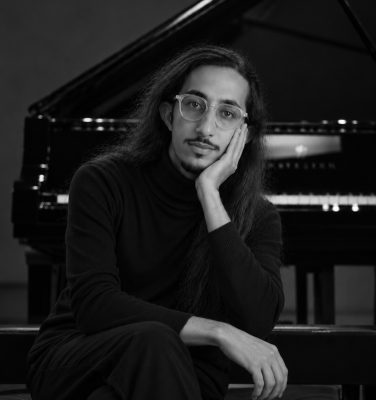
Habib Rahimi is an Iranian composer, researcher, and music educator currently pursuing a PhD in Music Composition at the University of Surrey, United Kingdom. His artistic practice encompasses acoustic, electroacoustic, and experimental music, with particular interests in spectral composition, timbral transformation, microtonality, and the relationship between contemporary compositional techniques and traditional Persian musical materials.
Rahimi studied composition at the Iran University of Art, where his research examined the structural and perceptual relationships between harmonicity and inharmonicity in spectral music, with particular reference to works by Gérard Grisey, Tristan Murail, and Kaija Saariaho. His current doctoral research builds on these interests, investigating spectral polarisation as a compositional method and exploring the transformation of Persian Radif materials through contemporary compositional approaches.
His compositions have received recognition in national and international contemporary music programmes and competitions. He received an award in the Classical and Contemporary Music category of Iran’s 18th National Festival of Youth Music (2025), and his works have been selected for initiatives including the International Vibraphone Project (USA), the Kariz Project, the Quater Ensemble Open Call, and the TCS Festival at Silent Green in Berlin.
Alongside his compositional activities, Rahimi has taught composition, music theory, organology, and related subjects at several educational institutions in Iran, including the National University of Skill, the Tehran School of Broadcasting, and the Tehran Boys’ Music Conservatory. He has also been actively involved in musicological research and contemporary music initiatives, serving as a board member of the Iranian Musicological Society.
His work reflects an ongoing interest in the intersections of sound, perception, cultural memory, and musical structure, seeking new possibilities for dialogue between contemporary musical thought and the traditions of Iranian music.