
A composition For Piano and Electroacoustic by Luis Angel
Developed through the 2025 Summer Composing Mentorship
Mentored by Soheil Shirangi
Piano:Qin Lan Zhang
Published by Zang Records in September 2026
This piece explores the interactions between spoken voice, electronics, and piano through a poem that plays with the rhythm of words, their meanings, and the images they evoke. The poem serves as a rhythmic, melodic, and conceptual guide for the music. Words intertwine and dissolve with the electronics and piano, leading the musical ideas to almost primitive states, where the listener begins to discover new meanings while simultaneously immersing themselves in the experience of pure sound. Credits: Poem and voice by Karen Venus Blackineel, composition by Luis Ángel Orduña, Gutiérrez
This piece explores the boundaries between language and music, as the poem becomes both a structural guide and a pathway into the experience of pure sound. The spoken voice is not only a vehicle of meaning, but also a source of rhythm, melody, and texture. By placing the poem at the center, the work allows words to oscillate between their semantic dimension and their purely sonic qualities. This duality generates a musical space where meaning can dissolve, reappear, and transform. Electronics and piano extend the possibilities of the voice, creating a dialogue that blurs the distinction between text and sound. Sometimes the words lead the music, suggesting rhythm or contour; at other times, they are absorbed into the instrumental and electronic layers, losing their recognizable form. The poem, in this way, acts simultaneously as a map and as a catalyst: it structures the musical discourse while also liberating it from fixed interpretation.
The journey toward pure sound does not imply abandoning meaning, but rather approaching it from multiple perspectives. For the listener, this opens up a field of perception where language is no longer constrained to communication, but becomes an experience in itself. What emerges is a search for a more primal state of listening—one that values resonance, rhythm, and timbre as much as narrative or symbol. Ultimately, the piece questions where language ends and music begins, or whether such a boundary truly exists. By intertwining voice, electronics, and piano, it invites the audience to inhabit that threshold, and to find in sound both the echo of words and the possibility of new
meanings
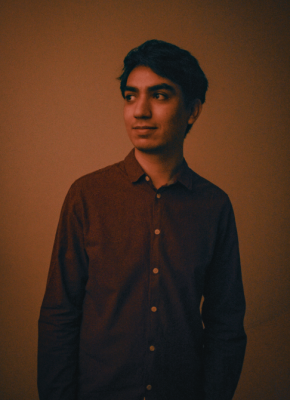
Luis Ángel Orduña Gutiérrez is an audiovisual artist based in Mexico. He studied musical composition at the Academia de Arte de Florencia in Mexico City. His work focuses on experimental visual and sonic creation through his project Ranura Vacía, with which he has presented his work at festivals such as LPM in Münster, Germany, and Kino Mural in Wroclaw, Poland. He is also the leader and composer of the musical project Antiánima, which has been presented at festivals such as Jazz Burghausen and Jazzahead!, both in Germany.