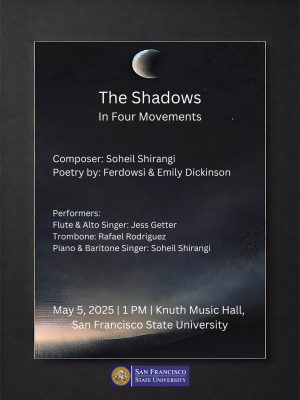
The Shadows (in Four Movements)
Composer: Soheil Shirangi • Poetry by: Ferdowsi & Emily Dickinson
Performers:
Flute & Alto Voice – Jess Getter • Trombone – Rafael Rodriguez • Piano & Baritone Voice – Soheil Shirangi
Premiere: May 5, 2025 | 1 PM | Knuth Music Hall, San Francisco State University
The Shadows is a journey through time—past, present, and future—told through music and poetry. Shadows are not just darkness. They are traces of what was, reflections of what is, and signs of what may come. Though we do not choose our past, it shapes our present and guides our future.
This four-part work blends electronic and acoustic sounds with live instruments and voice, creating a space where time feels soft and flowing. The words of Ferdowsi and Emily Dickinson bring life to the music—Ferdowsi speaks of history and strength, while Dickinson reflects on life, death, and what lies beyond.
This piece invites the listener to step into the shadows—not to fear them, but to listen, to reflect, and to understand how the past lives within us and helps shape who we become.
- Awakening Memory: For Electronic, Electroacoustic, and Varieties of Radio Sounds.
This movement begins like the first breath of thought—a quiet awakening through sound. Electronic tones rise and mix with radio noise, like forgotten voices trying to speak through time. It feels as if the past isn’t behind us, but hidden inside every vibration and silence. Here, sound becomes memory, and technology becomes a bridge between what once was and what still remains. - Effective Wisdom: For Electronic, Electroacoustic, Piano, Baritone Voice & Trombone.
This movement is deep and powerful. The baritone voice sings lines from Ferdowsi’s Shahnameh, sharing stories of bravery, destiny, and human strength. The piano and electronics echo like the stones of ancient cities, still full of memory. This is more than remembering—it’s reliving. Through layers of sound, old wisdom comes alive again, strong and meaningful.
III. Free Memory: For Electronic, Electroacoustic, Piano, Flute & Trombone.
This movement grows slowly, like a dream that is fading. It begins with soft electronic waves that move gently, like shadows at sunset. The piano plays quietly and thoughtfully. Then the flute holds a long, still note—like the sky keeping the last light of day. Finally, the trombone adds warmth and sorrow. Time here feels soft and uncertain. What is real and what is remembered begin to blur, and we are left in a quiet space in between.
IV. Spiritual Remembering: For Electronic, Electroacoustic, Piano, Alto Voice & Trombone.
The final movement is built on a poem by Emily Dickinson, a poet who wrote deeply about life, death, and the invisible world around us. It begins with slow, wide electronic sounds, like looking into the night sky. The piano and trombone enter gently, preparing us for something sacred.
When the alto voice begins to sing Dickinson’s words, it feels like a soft light entering a dark room. The poem speaks of letting go, of crossing into something unknown but kind. The music doesn’t simply end—it fades, like light dissolving into mist. We are left not with silence, but with peace, as if we’ve stepped into a quiet, eternal world full of wonder.